Tuesday, June 10, 2014

Be going to for elementary students of English

Are you going to teach or learn the form “BE GOING TO” for expressing future? This post might come handy. There is a mind map explaining all the forms: Affirmative sentences, negative sentences and questions.
This post is especially designed for elementary students who need to learn the form. 

Be going to mind map

Friday, May 9, 2014

Simple way to know whether TO or ING should be used.

The rule goes like this: “If the first verb happens before the second verb, use TOIf the second verb happens at the same time or before the first verb use the ending -ING with the second verb. For example: I want to go out. (First I want and then I will go out) She stopped smoking. (First she smoked and then she stopped.) He agreed to do it. (First he agreed and then he did it)”
Simple, isn’t it? However, you have to be careful as the rule does not work for the verbs suggest, pretend and fail.
Below you can see the idea in a mind map and lower you can test it in several games.


Friday, April 25, 2014

So, you think English is easy....


You think English is easy? Think again.  Read all the way to the end.................

1.      The bandage was wound around the wound.
2.      The farm was used to produce produce.
3.      The dump was so full that it had to refuse more refuse.
4.      We must polish the Polish furniture...
5.      He could lead if he would get the lead out.
6.      The soldier decided to desert his dessert in the desert..
7.      Since there is no time like the present, he thought it was time topresentthe present..
8.      bass was painted on the head of the bass drum.
9.      When shot at, the dove dove into the bushes.
10.  I did not object to the object.
11.  The insurance was invalid for the invalid.
12.  There was a row among the oarsmen about how to row..
13.  They were too close to the door to close it.
14.  The buck does funny things when the does are present.
15.  A seamstress and a sewer fell down into a sewer line.
16.  To help with planting, the farmer taught his sow to sow.
17.  The wind was too strong to wind the sail.
18.  Upon seeing the tear in the painting I shed a tear..
19.  I had to subject the subject to a series of tests.
20.  How can I intimate this to my most intimate friend?

Let's face it - English is a crazy language. There is no egg in eggplant, nor ham in  hamburger; neither apple nor pine in pineapple. English muffins weren't invented  in England or French fries in France . Sweetmeats are candies while sweetbreads,  which aren't sweet, are meat. We take English for granted. But if we explore its  paradoxes, we find that quicksand can work slowly, boxing rings are square and a  guinea pig is neither from Guinea nor is it a pig.

And why is it that writers write but fingers don't fing, grocers don't groce and hammers don't ham? If the plural of tooth is teeth, why isn't the plural of booth, beeth? One  goose, 2 geese. So one moose, 2 meese? One index, 2 indices? Doesn't it seem  crazy that you can make amends but not one amend? If you have a bunch of odds  and ends and get rid of all but one of them, what do you call it?

If teachers taught, why didn't preachers praught? If a vegetarian eats vegetables,  what does a humanitarian eat? Sometimes I think all the English speakers should  be committed to an asylum for the verbally insane. In what language do people  recite at a play and play at a recital? Ship by truck and send cargo by ship?  Have noses that run and feet that smell?

How can a slim chance and a fat chance be the same, while a wise man and a wise guy  are opposites? You have to marvel at the unique lunacy of a language in which  your house can burn up as it burns down, in which you fill in a form by filling  it out and in which, an alarm goes off by going on.

English was invented by people, not computers, and it reflects the creativity of the human race,  which, of course, is not a race at all. That is why, when the stars are out,  they are visible, but when the lights are out, they are invisible.
PS. - Why doesn't 'Buick' rhyme with 'quick'?

Teachers of the English language might enjoy pondering this.

There is a two-letter word that perhaps has more meanings than any other two-letter word, and that is 'UP.' It's easy to understand UP meaning toward the sky or at the top of the list, but…
·          When we awaken in the morning, why do we wake UP?
·         At a meeting, why does a topic come UP?
·         Why do we speak UP and why are the officers UP for election and why is it UP to the secretary to write UP a report?
·         We call UP our friends.
·          And we use it to brighten UP a room, polish UP the silver; we warm UPthe leftovers and clean UP the kitchen.
·          We lock UP the house and some guys fix UP the old car.

At other times the little word has real special meaning.
·         People stir UP trouble, line UP for tickets, work UP an appetite, and thinkUPexcuses.
·          To be dressed is one thing, but to be dressed UP is special..
·          A drain must be opened UP because it is stopped UP.
·          We open UP a store in the morning but we close it UP at night.
·          We seem to be pretty mixed UP about UP!
·         To be knowledgeable about the proper uses of UP, look the word UP in the dictionary.
·         In a desk-sized dictionary, it takes UP almost 1/4th of the page and can add UP to about thirty definitions.

If you are UP to it, you might try building UP  a list of the many ways UP is used.  It will take UP a lot of your time, but if you don't give UP, you may wind UP with a hundred or more.
·          When it threatens to rain, we say it is clouding UP.
·          When the sun comes out we say it is clearing UP..
·          When it rains, it wets the earth and often messes things UP.
·          When it doesn't rain for awhile, things dry UP.
·         One could go on and on, but I'll wrap it UP, for now my time is UP, so.......it is time to shut UP!

Now it's UP to you what you do with this blog post.


http://sfltdu.blogspot.com/

Sunday, April 13, 2014

Modal verbs – mind map

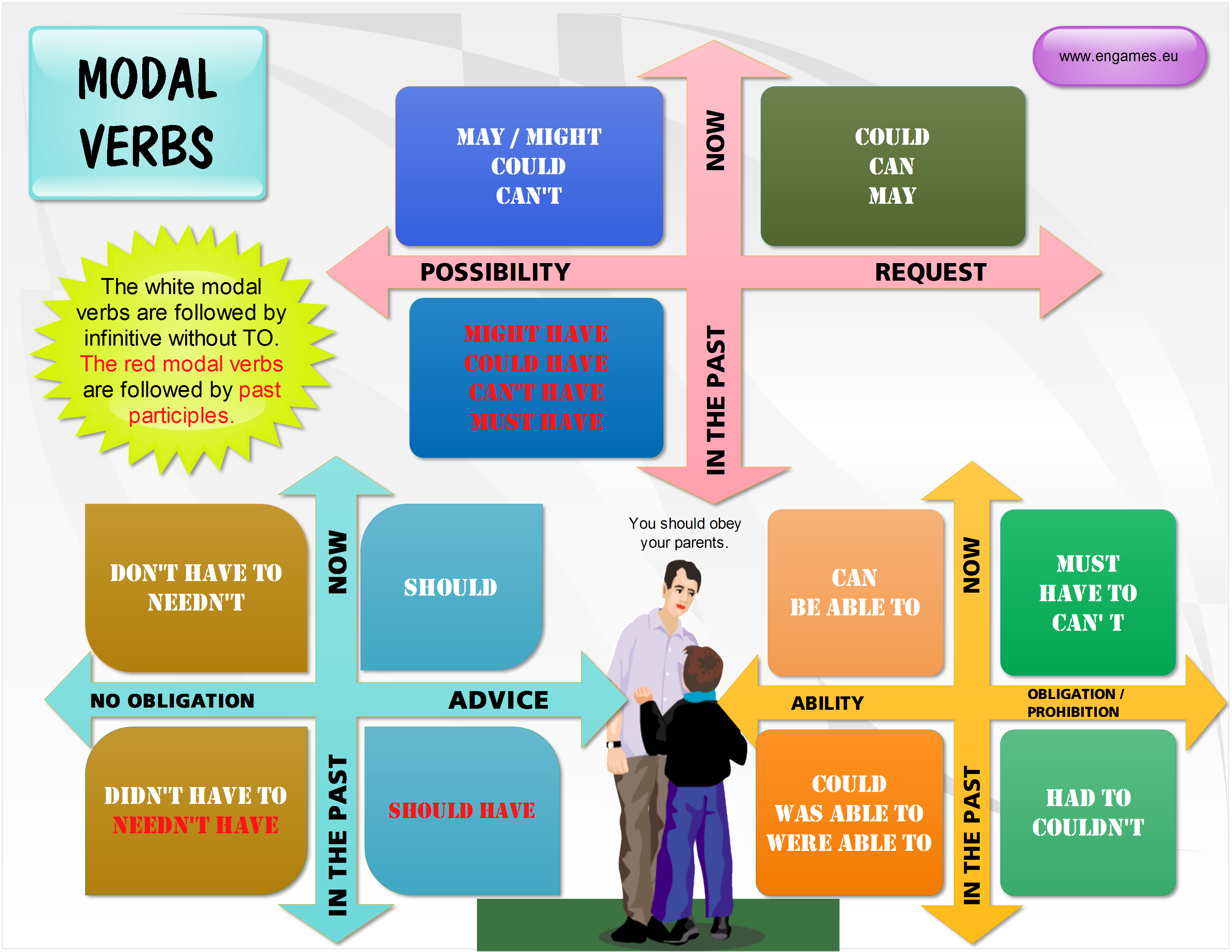
Students usually understand the usage of the modals in present tense very quickly. However, when they start speaking about the past, they use the present tense or some non-existent forms, like “musted”.
Here I’ve tried to create a simple overview of all the modal verbs and their usage in present and past tenses. I hope you will find it at least a bit useful.

Have a look at this mind map. Notice that the modal verbs are in two colours.The white modal verbs are followed by an infinitive without to and the red modal verbs are followed by past participles. If you still have problems with the past participles please follow the link above or this one, which will take you to quizzes on past participles at our other site English Learning Magazine.

Modal verbs past and present tense mind map

Modal verbs – games

Once you have understood the explanation, it is time to practise your knowledge in two games on Modal verbs. The first one is called En Garde and your task is to choose the correct modal verb and then hit your opponent.
Modal verbs – En Garde
The second game is called Penalty. Once again you should choose the correct modal verb and then try to score a goal. Will you succeed?
Modal verbs – Penalty

English Learning Magazine

We have started a new site for learners of English. While this site contains short grammar explanations and games to practise the grammar, the new sitewww.englishlearningmagazine.com contains tests and quizzes to practise English in general. For example, there is a text on Easter and you have to answer comprehension questions and then reconstruct the text.
Or you could practise the names of the plants in a post which contains the video with the names of the plants and three tests. Moreover, you can listen to a song and complete its lyrics.
The whole site is mobile phones friendly (unlike this one, where the games play only on desktops).
Enjoy.

Wednesday, April 9, 2014

Numbers – learn to read and write numbers in English


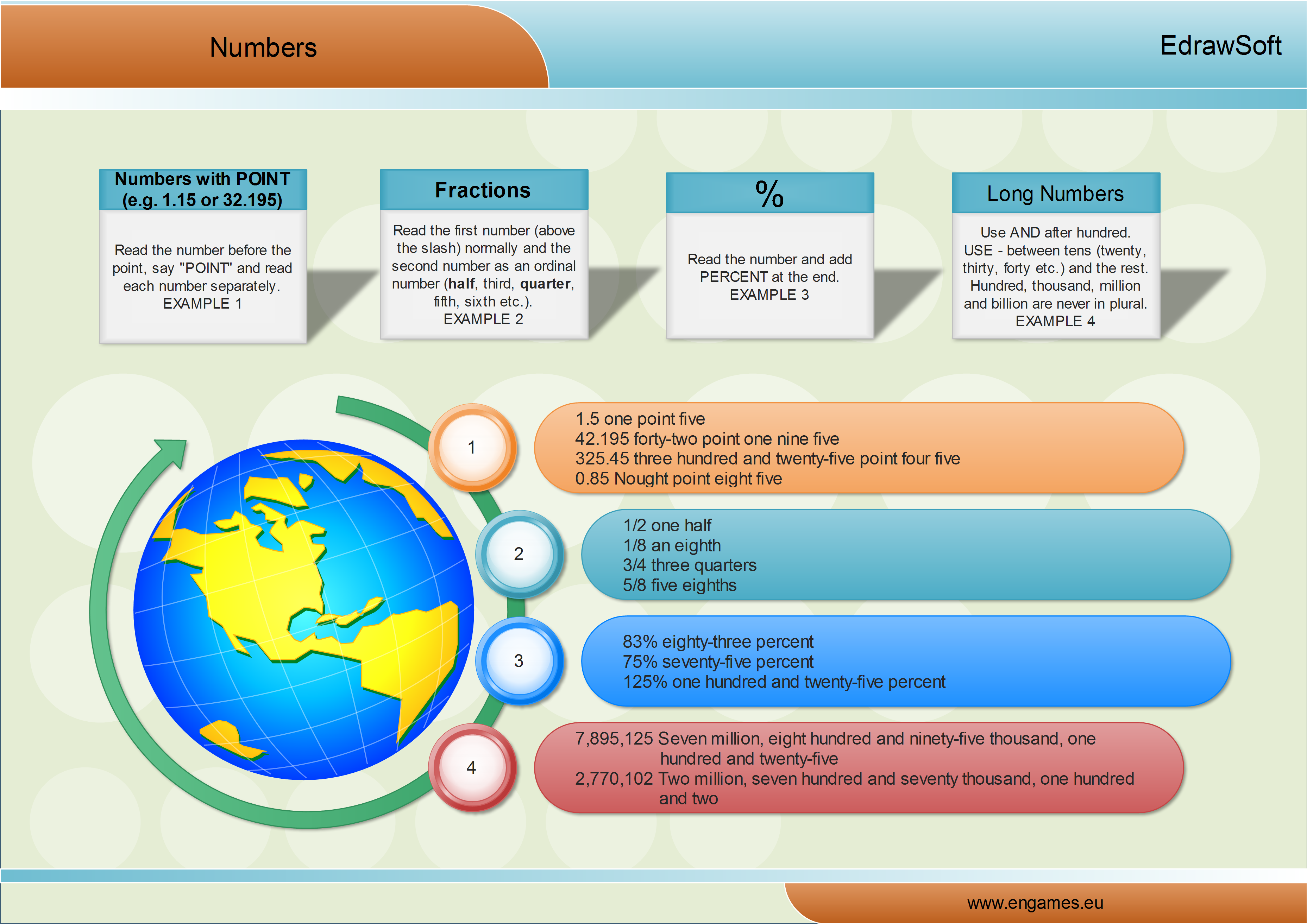
Learn English numbers
Numbers explanation

Numbers – mind map

In the following section you can find several games to practise numbers. The games are ordered from the easiest to the most difficult.
The first game is called Half a minute and your task is to write the number within half a minute. In fractions use a slash (/).
Click Here to play the game – Half a minute
The second game is called Teacher invaders and your task is similar to the previous game. You should write the numbers correctly andsave the Earth against the Teacher invaders.
Click Here to play the game – Teacher Invaders
The last game is the most difficult one. It is called On Target and you should choose the correct way that a number is written in words. When we played the game at school the students got only 40% of the answers right. Will you be better than them?
Click Here to play the game – On target

Conclusion

I hope that by now you know the ways to read and write numbers in English. If you want to learn more English vocabulary, you can try here AnimalsFurnitureor Plants. Each of the posts contains a video, a mind map and several games to practise the words. Enjoy

ENGLISH FOR MEDICINE

Another subject you asked for was medical English, so check out these great links for lots of vocabulary, listening and reading practice! 

1) Interactive tutorials on more than 200 medical topics with downloadable PDF files - http://www.nlm.nih.gov/medlineplus/tutorials/
2) English for Medicine activities - http://www.britishcouncil.org/professionals-specialisms-medicine-intro.htm
3) Professional Podcast: a doctor's view - http://learnenglish.britishcouncil.org/en/professionals-podcasts/english-medicine-doctors-view
4) Medical Vocabulary Builder - http://www.learnenglish.org.uk/profsLessons/flash/vocabBuilderWrapper.htm
5) Interactive anatomy - http://www.innerbody.com/